Sunday, July 10, 2016

Day 11 and 12: June 5 & 6

Sunday June 5

It rained last night, which sounded really nice in the tent.  That meant that it was cloudy in the morning as I tried to find my Hermit Thrush (dubbed HETH 3), that I had caught yesterday.  No luck.  I climbed up and down that mountain slope, and got zip.  When trying with Edward's receiver, he got a signal, and my mentor John Gerwin joined us.  We chased the thrush to a fern bed...and didn't even see the bird.  You have to estimate a lot when doing radio telemetry, because half the time (or more) you don't see the bird because it flushed/flew away.  So I marked the point with a GPS and recorded the coordinates, and went out on my own to try to find the bird.  I chased it down another mountain and across a ravine, where I finally got a clear view of where it was.  Telemetry is basically this: patience, determination, and purposeful walking.  I know all of you are planning to do telemetry at some point, so now you know.

Lunch :)

It was actually only Edward, Vanessa, and I eating lunch by the trail that afternoon, because John was busy untangling a Hermit Thrush from the net.  He caught this thrush in order to put color bands on it.  I have a vision of the trail with thrushes with different color bands branching out on either side of the trail: a visual map of how many thrushes/thrush pairs are in that specific area.  Hermit Thrushes are little-known because barely anyone has studied them, so it's our job to collect as much data as possible on these birds now.


Well, then the rain came.  We decided to stop doing telemetry, and took a drive up to Mt. Mitchell to look at the small museum they had there.  It was really cool!  There was a lot of historic information about Mitchell himself, and the man who found his dead body, Tom Wilson.  Tom Wilson was a longtime land owner in the Mitchell area, and his family still owns land there today.   The Park Service and Forest Service salivate over that land, but they can't do anything to it since the Wilson family won't give it up.

I saw two lifers today, meaning two birds that I have never seen before.  The first was a Canada Warbler, which is a beautiful small warbler that breeds in the mountains.  We all saw it on the drive up to the study trail that morning, and it responded to the playback that Edward played.  It has a necklace of black encircling its throat, and bold black markings on the face.  It's white eye ring is prominent on it's blue face.  They have a beautiful light song too.  The other lifer was a Veery, a close relative to a Hermit Thrush.  It flew across the road, and we called it back in using playback in order to get a better look at it.  They have a dusting of light brown/cinnamon spots on the breast, unlike the dark brown, ample amount of spots on the Hermit Thrush and Wood Thrush.  They are also a lighter brown on the back.  Their song is strange but lovely: a metallic whirring downward spiral.


Monday June 6

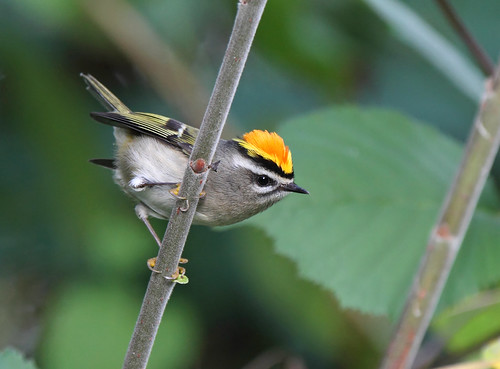
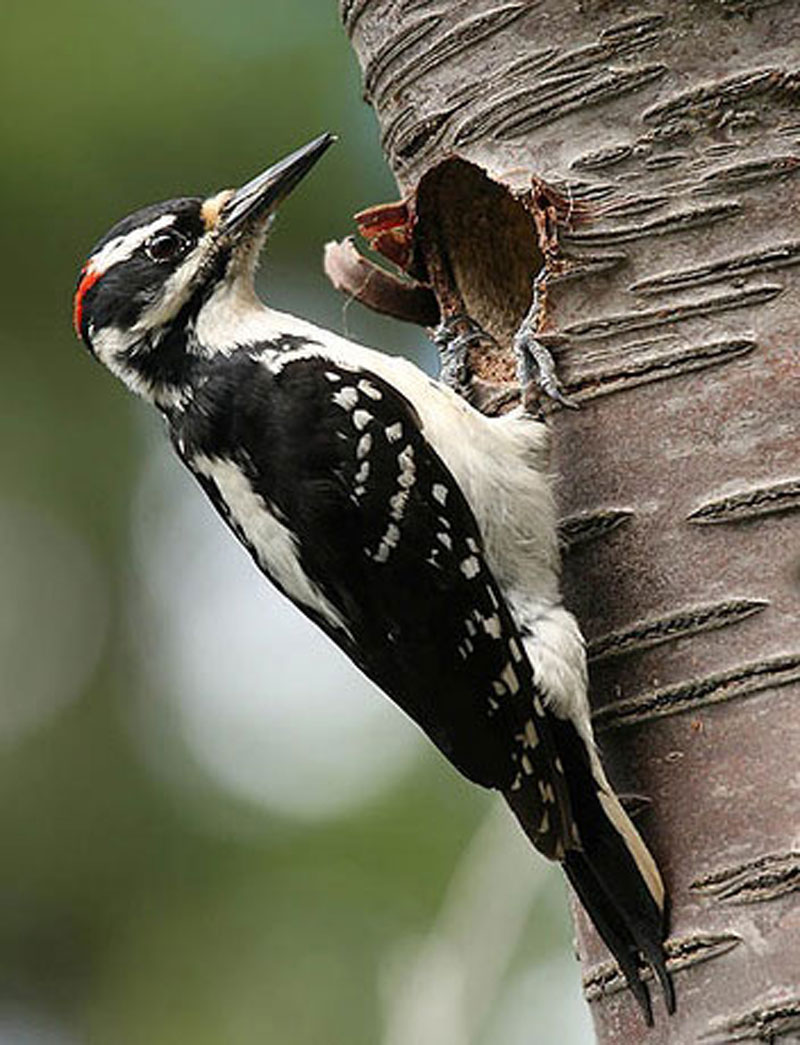
So we got up a little late this morning, and packed up our stuff.  Then we went to a gas station ten minutes away so that John could fill up his tank, and by then it was 9:30.  Who cares? is what we said.  We went up to the BKR Trail--John and Edward to do more telemetry, and Vanessa and I to scout out for a Blackburnian Warbler nest.  I have dubbed Blackburnian Warblers as Cheeto birds, because that's what they look like.  The males have this ridiculously bright patch of orange on their throats and faces, whereas the females have a butter yellow instead.  We had seen a female on the trail collecting nest material, and so we went to see if we could follow her to her nest.  Except we didn't see her until we had given up because we had to drive home.  We saw her then, peering at the both of us, then flitting away.  Then she didn't come back, and though we saw the Cheeto male, he was high up in a conifer foraging, thus wouldn't be helping with the nest-building. Oh, well, it was interesting to see the two of them, and some Golden-crowned Kinglets and a Hairy Woodpecker along the way.

We drove home listening to NPR and the Avett Brothers--what better mix is there than that?


Blackburnian Warbler male: See? It's a Cheeto bird
Canada Warbler male
Veery!
Happy Golden-crowned Kinglet (what you usually see). . .
Angry Golden-crowned Kinglet

Hairy Woodpecker

And, last but not least:
THE AVETT BROTHERS--so awesome


Friday, June 24, 2016

Day 9 and 10: June 3 & 4, 2016

DAYS #1-2 of Mountains

Vanessa, my aforementioned mentor John (who works at the Museum of Natural Sciences), Edward, an NC State student who does a ton of stuff with John like we do, and me were the four researchers during this mountain trip.  We slept in the first day (a blissful 6:30am. . .WAIT WHAT my body screamed), and drove up some more mountain before reaching the beautiful Ridge Junction Overlook, whose elevation is 5,160 feet.  I could see Mt. Mitchell, the tallest peak east of the Mississippi (6,684 ft tall), Potato Knob (yes, that is the name of it--it's better than Little and Big Butt, which are two other mountains in this region), and Mt. Gibbs.  This habitat--that is, habitat in the mountains above 5,000 feet--it's called spruce-fir, because there are, you guessed it, a lot red spruce and Fraser fir trees that make up the terrain.  Firs have majorly declined in numbers, though, because of an invasive pest called the balsam woolly adelgid.  Anyway, think of elevation as latitude, since the tops of the Black Mountains habitat is equivalent to southern Canada.  As elevation rises, the habitat is more similar to the rising of latitude.  I think it's pretty amazing, the way habitat is so diverse and confined, yet correlations can be made between regions.

 The Black Mountain Range

After looking out at the outlook(ing), the team went to Bald Knob Ridge Trail, the location of all of our soon-to-be thrush subjects.  This new study was focused on Hermit Thrushes (Catharus guttatus), who are not very well-researched at all.  A couple living in the mountains have found the first few Hermit Thrush nests in North Carolina.  This study is seeing how the thrushes move around their territories during breeding season, and how big their territories are in general.  If we are lucky, we will find a nest.

Hermit Thrush (transmitter frequency 150.615)


We split up--John and Vanessa pairing up, and me and Edward together--and set up mist nets first.  Mist nets, as I've explained in my first post, are volleyball-like nets (with way smaller holes), that have five pockets that birds fly into relatively harmlessly (unfortunately, with research, there are always exceptions, and birds do rarely get injured in these nets).  We did playback (playing a recording of a bird song) to incite the hermit thrush males to the site and hopefully fly into the net.  John and Vanessa got a male shortly after starting playback, and Edward and I met with them to put the radio transmitter on the bird.  Radio transmitters are small devices that send out a signal at a certain frequency.  Their battery is a hearing aid battery, and the transmitters have to be light enough to not add too much weight onto the birds (under 5% of a bird's body weight).  There is a tiny antenna thing going out of the transmitter so that it can actually emit the signal, and it looks like a black, stiff string.  The transmitter goes onto the bird like a backpack, where you have to tie a string (it's actually surgical string so it's a little flexible) into two loops that the bird's legs go into.  The transmitter, with the antenna counterpart, goes on the back of the bird, so the bird is of course still completely free to move and fly.  If, in a case where the transmitter is on too tight (the loops were tightened too much), this can be seen when the bird is released to go off and be a bird--it won't fly upward, or it won't fly at all.  Then biologists run over to the bird to capture it and take the transmitter off.  This is rare, though!!

So, when John and Vanessa caught the first Hermit Thrush, we put a radio transmitter on him.  All of the birds that we put transmitters on (three total) were males, because the males are the territorial, I'm-gonna-protect-my-mate ones of the relationship.  The females are incubating at this time in the summer, or are feeding their chicks with the males.  Or, they're forever scoping out other males' territories to see who has the best territory--better territory to them = better male which could = better survival for offspring.  Females, essentially, usually stay out of territorial confrontations, because they are doing their own thing, sometimes behind their mates' backs.  Keep in mind that I am generalizing.  Anyway, that is the long-winded way of saying that, over these two days we caught three males and put transmitters on them, and they got caught in the nets because they were being defensive of their territory.  We played a recording of a Hermit Thrush song so that the males would think that a male was singing in their territory.  It was teamwork, strategy, and skill all combined and it was amazing.  It was amazing to work hard and with purpose, doing the work of a researcher.  Camping was fun too, though it takes time to adjust to cooking with a propane stove, and having to put every single item of food in the car so as not to attract bears.  That was scary, but no bears were encountered during the making of this study :)

Hermit Thrush Subjects
Radio Telemetry...is hard

Vanessa and John putting a transmitter on a bird.  V is trying to brush feathers out from under the string of the "backpack" (the transmitter), so that, when the thrush preens later, the feathers removed from under the string do not make the transmitter loose enough to allow the bird to get out of it (this has happened before).
See the black stiff string sticking out?  That's the antenna of the transmitter.  The transmitter's core is the gadget in the center of this thrush's back.  And the backpack part are the two loops coming out from the transmitter's core--one loop for each leg.
Transmitter Frequency 150.615
For all of the birds that we put transmitters on, we did what is called color banding.  We always put the regular silver band with the unique number on it, but we also added a few colored, plastic bands to the feet so that we could identify the individual without using technology (like the radio telemetry receiver, or having to somehow read the unique silver band number to see what bird it is).
Transmitter Frequency 150.659
This was the second thrush that we put a transmitter on.  These color bands proved to be very helpful a few weeks later as we banded more thrushes and had to be able to identify them by the color combination on bands.
And there was another bird that we put a transmitter on, but I do not have those photos right now.

Friday, June 10, 2016

It's been a while. . .

Hi, and I'm sorry that it has been so long since blogging.  Last week was pretty hectic after Memorial Day, since I bought Spain tickets (!!!!!) and hung out with my family, went to IB graduation, then graduation rehearsal, then straight to the Blue Ridge Mountains for five days.  And in the mountains, the service is, if anything, spotty.  This makes me glad that I don't treat my phone like a vital organ/limb like too many people seem to.

So, Spain.  Vanessa and I are going with our parents September 6th, and traveling around Spain and a little bit of France until September 27th.  Our parents will leave then, and V and I will stay with our grandmother in a town called Alhaurín de la Torre, right outside of the city Málaga.  There will be many excursions during the month-and-a-half we are staying in Alhaurín, and the prominent activity will consist of birding.  In October, it's migration season, meaning hundreds of bird species are flying south and into northern Africa for the winter.

Me + migration = me freaking out because I can see birds I wouldn't normally get to see but now I can since all of these different species will be passing through.

I think that equation, rather than clearing things up, made everything really confusing.  Long story short, I am going to be really happy in Spain.  My uncle will come in mid-November to visit me and my sister in Spain, and then we'll all go and travel in Europe for a week-ish, ending in England.  My uncle has friends in London and somewhere in northern England, so we will visit both of those places.  On November 22nd, the three of us will say goodbye to Europe and head back home.  Sounds pretty awesome, right?

But that's months away.  For now, I am thinking about that little event called graduation that's happening in 4.5 hours.  It'll be great to eat out at Fiction Kitchen (they have the best fake chicken you will ever eat), and see my friends (for the last time??  Some of them, maybe).  Last Wednesday was IB graduation, and I got to spend an early morning filling Baron's (our IB coordinator) office with 800 balloons that I and fellow IB peers had blown up the day before.  It was GREAT.  The look on Baron's face when he banged his head into the wall in exasperation was absolutely hilarious.  He really did appreciate it, though.  That evening was IB graduation, and all 55 of us socialized and listened to some great speakers.  Dawson was the absolute best though, as our unofficial IB class spokesman at all times.  The reception consisted of a lot of picture-taking and hugging, and senior superlatives were happily doled out to all of us.  I got "Biggest Heart," which promptly made my heart swell up with happiness!

Graduation rehearsal on Thursday was, true to it's name, boring, though it was nice to see classmates and friends in a kind-of non-school setting.

Right after rehearsal, Vanessa and I drove for five hours to the Black Mountains to help with a bird study my mentor and friend started the day before.  I'll post about that soon...


Saturday, May 28, 2016

Day 3: May 28, 2016

Today I got up at 6:45 and led a bird walk with Vanessa and my friend Emma.  All three of us are obviously interested in birds, and so we were asked to lead a bird walk for kids in Wake Audubon's Young Naturalist club.  It was really fun--only three kids came, but they and the Young Naturalist leader Jennifer saw at least one bird species they had never seen before.  We saw two yellow-billed cuckoos, large birds that are very difficult to see because they just sit very still in a tree and give this clucking call.  But, we found a pair of these cuckoos, first hearing them, then playing its call from a phone to see if it would come in.  It did!  We eventually tracked it down, perching about 20 feet up in a tree, and saw its mate close by.  That was probably the coolest part of the walk--seeing these elusive birds.  I also enjoyed teaching the kids about how to identify birds, and listening to songs to try to identify what was calling.  One kid knew better than me though!  He'll probably leading the bird walk in a few years.

I saw the goats again (they stayed for a day) and they had eaten a lot of greenery in the backyard!  There were still patches of groundcover, but I was impressed by the amount of damage 20 goats can do in 18 hours.

I went to the gym with Vanessa, then spent a few hours at my neighbor's pool-opening party.  It's always nice to talk with neighbors, because usually there are endless funny stories to be told or memories to be remembered.  And the food is always a major plus :)

I will probably not blog for the next few days, because I am not going anywhere extraordinary or doing anything crazy, just spending some wonderful time with family.  Peace!

Day 2: May 27, 2016


Today was a relaxing day where I got nothing done.  I firmly believe that everyone needs days like these every so often :).  I hung out with my friend Emma and Vanessa; reading, going to the library.  We went to our neighbor's house, who rented out goats (apparently that's a thing) to demolish/eat everything green and unmanageable in their backyard. The goats were awesome!  There were 20 of them, all of different sizes and coat colors, and they were just munching away at the weeds, vines, and saplings in the yard.  I went into the yard, observed all of the docile goats, and managed to pet a few, and feed a couple some leaves and bark.  That's something I will probably never get to say again, so I was glad to have that experience, albeit strange!  An N & O photographer came too, since our neighbor, David Menconi, writes for that newspaper and was going to do a story on his family's goat adventure.

Once seeing the goats, my family and I went to Millbrook's Dance and Drama Awards.  It was very fun, and I really enjoyed seeing the same old theater and dance students.  Last awards ceremony forever!

All of the goat diversity!  I was expecting 20 white or gray goats, not the handful of coat colors and sizes.  The one black goat above has tiny ears, kind of truncated-looking, while the others have the long, soft ears.  And some goats really like an ear or back scratch, so they just come up to you, give you a nudge, or stand awkwardly close until you realize that they want you to pet them.  And a few goats ambled up to my hand, sniffed it with their soft muzzles, and casually nibbled it to see if it was a leaf.  I then casually moved my hand away...no, it didn't hurt at all, and they quickly learned that my hand was a petting, not edible, object.

Thursday, May 26, 2016

Day 1: May 26, 2016

Today I did bird banding at Prairie Ridge Ecostation in Raleigh.  Bird banding consists of catching birds in mist nets--nets made for catching birds because they have pockets that the birds fly and fall into, getting tangled--and putting small aluminum or color bands on their feet.  Bird banding is important because scientists collect data about each individual bird, like body fat, molt, sex, age, and this can be used to get a general idea about the characteristics of a species.  Also, every bird gets an aluminum band etched with a specific number.  If the same group or a different group somewhere in the US catches the bird again, the number on the band can be used to identify the individual.  So, scientists use this to see a) where the bird goes and if it migrates, b) if the bird returns to one place every year, and c) how long that bird species' lifespan is.

I have been bird banding for about four years now, and I still really enjoy it and learn a lot from it.  Today, I bird banded with Vanessa, John Gerwin, the ornithologist that taught me everything, and another student named Edward.  We bird banded near some bird feeders so that we could hopefully get many birds in a short amount of time.  This didn't happen--we caught around 8 birds in 2.5 - 3 hours, but that's how science is: unpredictable.  The weather anchor for WRAL, Elizabeth Gardener, likes to do the noon weather report by the Museum of Natural Sciences, where my mentor John Gerwin works.  So, she came to do the noon report at Prairie Ridge and interviewed John about bird banding.  It was really cool!  She's very nice, and I'm pretty sure she smiled the entire hour she was there.

The birds that were caught were: Common Grackle, Brown-headed Cowbird, European Starling (all were babies/juveniles), Carolina Chickadee, House Wren.  The last two bird species were target species for this project called Neighborhood Nestwatch.  It's a project that the Smithsonian Museum is doing in eight different cities around the US, and Raleigh is one of them.  Different groups go around bird banding in people's yards (with their permission, of course) and putting easily identifiable color bands on the target species.  So it was nice to get the House Wren and a few chickadees.

After bird banding, my sister and I went home and cared for our poor dog, Gus, who got into a fight yesterday with another of our sweet dogs Wall-E.  I ate dinner with my friend and her family.  Great first day to my gap year, save that two of my dogs are recovering from a fight.

The bird banding table (it's always like this :)

Vanessa holding a Common Grackle
John Gerwin holding a Carolina Chickadee.  You can see the color bands on it's feet, and the tail feather shape.

Vanessa removing a Brown-headed Cowbird from a net

A toad!